 |
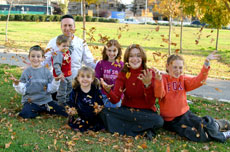
| Mitch and Tamar Rudi with their family in Israel |
They followed their dreams and those of the Jewish people from ages past.
For many immigrants to Israel, making aliyah — literally, going up — is a spiritual ascent, for most an arduous trek over tricky bureaucratic terrain, for all a life-changing adventure.
According to the Jewish Agency of Israel, of the more than 3.5 million people who over the past century and a half have made the Promised Land their permanent home, about 130,000 have come from the United States. The agency does not have a precise figure of those who hailed from Baltimore, but the likely number is in the thousands.
The most recent emigrants were Aviva and Joshua Spotts, who left their Heather Ridge townhouse in August with four children in tow and boarded a flight to Israel chartered by Nefesh B’Nefesh, a highly organized and idealistic group founded in 2002 that works to minimize the financial, logistical and social obstacles faced by potential olim, immigrants to Israel.
A few weeks earlier, at least four families with Baltimore roots had taken similar flights with their children: Ilana and David Gottlieb (the rabbi at Congregation Shomrei Emunah for the past 10 years); Bryna (nee Schuchman) and Yaakov Handler; Shani (nee Katz) and Avi Berger; and Shira and David Greenstone; with, of course, all their children (some 16 among them).
In July, Nefesh B’Nefesh brought Rabbi Elan Adler and his family to Israel, the fulfillment of a long-held dream. He had been spiritual leader of the Moses Montefiore Anshe Emunah Hebrew Congregation for the past 10 years.
“I’m going to be with my peeps,” Rabbi Adler told the Baltimore Jewish Times just before he left. “This is where the whole Jewish community has its future.”
For the Adlers, the transition was virtually seamless. Shortly after they arrived at Ben Gurion Airport, they were whisked by car to a reception in their honor at the home of Elana and Rich Dresser, a few doors up the road from their new home in Ma’ale Adumim, a sparkling, modern town five miles east of Jerusalem. There, they were greeted by their new neighbors and other recent olim from Baltimore.
The Dressers came in 2007. Elana (nee Vogel) is a native Baltimorean. Rich received his medical degree from the University of Maryland and a master’s from Johns Hopkins University, where he was president of the Jewish Student Association at the School of Public Health. The Dressers made aliyah in 2007.
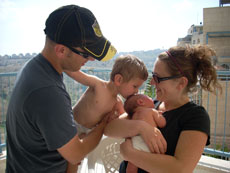 |
| Young families are making the move, such as Jason and Mandi Berman with Isaac and Ben. |
Beth and David Gordon, both born and raised in Baltimore, have been here since 2006. They met in high school (Beth went to Woodlawn, David to Pikesville). Their daughter, Mandi, and son-in-law, Jason Berman, and their two children joined them last year in Ma’ale Adumim. For Beth, “Your soul speaks to you here.”
Tamar and Ira Weissman also were there to greet the Adlers. She graduated from Bais Yaakov in 1994, met her husband (originally from Kendall, Fla.) at the University of Pennsylvania and made aliyah in 2001. The Weissmans and their five children moved to Ma’ale Adumim from Nof Ayalon, outside of Modi’in, just last week.
For Ms. Weissman, who teaches at Bar Ilan University and is a licensed Israeli tour guide, going from Baltimore to Israel was a spiritual affirmation.
“I’m positive that many would disagree with my definition of ‘the right thing to do,’ ” she wrote in a Baltimore Jewish Times op-ed before she left. “Is it right to put your children in harm’s way by living willingly in such a hostile area of the world ... to cause pain to your family by moving so far away and depriving them of regular interaction … to inadvertently disparage a wonderful community like Baltimore, with all of its kindness of character and solid religious infrastructure, by asserting that it would be better to live elsewhere?”
Then she answered her own questions. “Yes, it is a good, desired and correct action, if you are a Jew living in America in the 21st century, to seriously consider moving to Israel. The reasoning is quite simple and straightforward. We are a generation that has been granted an opportunity to fulfill that which is expected of us at this historical juncture — to take possession of our Land, to raise our families there and work there and join our collective nation on the land that God has set aside for us, the Jewish people.
“Kol Dodi dofek — the voice of my Beloved knocks — through the reverberations of the Holocaust, the founding of a Jewish state in our historical borders, the military and technological miracles that have shaken modern-day Israel. Who can be deaf? How pleasant is the Moroccan Jew and the American Jew and the Argentinian Jew living side by side as Israelis! How deeply satisfying to raise your children in the streets of Jerusalem and see them married and setting up ther homes in the cities of Judea! How sweet to call oneself a ben Eretz Yisrael, and not a Diaspora Jew!
“It is this unmatched sense of nachat ruach — tranquility of the soul — that must be part of the reward for those who have done what they believe is the right thing to do.”
Jerusalem Of America
When Mark Twain visited Palestine in 1867, he was struck by its “dismal scenery,” which he described in “Innocents Abroad”:
“The hills are barren, they are dull of color, they are un-picturesque in shape. The valleys are unsightly deserts fringed with a feeble vegetation that has an expression about it of being sorrowful and despondent. The Dead Sea and the Sea of Galilee sleep in the midst of a vast stretch of hill and plain wherein the eye rests upon no pleasant tint, no striking object, no soft picture dreaming in a purple haze or mottled with the shadows of the clouds. Every outline is harsh, every feature is distinct, there is no perspective — distance works no enchantment here. It is a hopeless, dreary, heart-broken land.”
Nevertheless, between 1882 and 1903, approximately 35,000 Jews immigrated to Palestine, then a province of the Ottoman Empire, in what has come to be known as “the First Aliyah.” The majority of them came from Russia, a smaller number from Yemen. Many established agricultural communities. Among the towns they established were Petach Tikvah, Rishon LeTzion, Rosh Pina and Zichron Yaakov. In 1882, the Yemenite Jews settled in an Arab suburb of Jerusalem called Silwan, just southeast of the Old City on the slopes of the Mount of Olives.
According to the “Encyclopedia Judaica,” Baltimore was a center of Zionism in the United States. Funds for Jews in Palestine were being collected here as early as 1847.
In 1897, Rabbi Hayyuim Jehiel Oshry, an itinerant rabbi and preacher from Lithuania who spoke at Zionist conventions and on behalf of the Jewish Colonial Bank, visited Baltimore, which he soon came to call “the Jerusalem of America.”
In 1900, the Federation of American Zionists held its first convention in Baltimore.
 |
| Mendy and Malky Newman with their children |
IA “Second Aliyah” took place between 1904 and 1914, with some 40,000 Jews immigrating to Palestine following numerous pogroms in their native Russia. Influenced by socialist ideals, this group set up the first kibbutz in Israel, Degania, in 1909. They also formed self-defense groups to ward off increasing Arab hostility and banditry. During this time, the suburb of Jaffa grew into the city of Tel Aviv, the national language of Hebrew was revived.
About 80 Baltimoreans volunteered to fight in the Jewish Legion, the British army unit that drove the Ottoman Turks from Palestine during WWI.
Although global aliyah has been steadily declining over previous years, the number of those arriving from North America and the United Kingdom is increasing. During the past eight years, Nefesh B’Nefesh has done much to revitalize Western aliyah, having brought more than 25,000 Jews from North America and the United Kingdom.
Szold And Speert
The first notable Baltimorean to make aliyah was Henrietta Szold, born in 1860, the eldest of eight daughters. Her father, Rabbi Benjamin Szold, was spiritual leader of Temple Oheb Shalom. In 1877, she graduated from Western Female High School; to further her own education, she attended public lectures at Johns Hopkins University and the Peabody Institute.
Had Henrietta Szold been born a century later, she probably would have become a rabbi. She was a dedicated and accomplished student of Judaism, and won permission to study Jewish texts at the then male-only Jewish Theological Seminary — on condition that she never agitated for ordination.
Instead, for 15 years Szold taught at “Miss Adams School” and Oheb Shalom, and gave Bible and history courses for adults. She established the first American night school to provide English language instruction and vocational skills to Russian Jewish immigrants in Baltimore.
Beginning in 1893, she worked for the Jewish Publication Society, a position she maintained for more than two decades. Later, she translated Heinrich Graetz’s monumental multi-volume “History of the Jews” from German into English.
In 1909, Szold took a trip to Palestine, where her commitment to Zionism was heightened. Three years later, she founded Hadassah, serving as its president until 1926. (Today, Hadassah is the largest Jewish organization in the United States.) In 1933, she immigrated to Palestine and helped run Youth Aliyah, an organization that rescued some 22,000 Jewish children from Nazi Europe.
In 1948, another Baltimorean, Mose I. Speert, was instrumental in collecting arms for the fledgling Jewish state. Quietly putting the word out among a tight-knit group of friends and WWII veterans, he gathered hundreds of pistols, rifles and other weapons and hid them behind a false wall in his former liquor warehouse at Lombard and Hanover streets. The weapons were transported by truck to New York, then shipped to Palestine.
Speert also played a key role in buying and outfitting an old Chesapeake Bay steamer, the President Warfield, and converting it into a vessel to carry nearly 5,000 Jewish refugees from Europe to Palestine, running the British blockade against Jewish immigration.
As the British turned a spotlight on the Warfield, it displayed a placard with a new name, Haganah Ship-Exodus 1947. Two of the destroyers rammed the Exodus and heavily armed British marines boarded it. The crew and passengers fought with their fists and cans of food. The passengers of the Exodus had expected to be diverted to a displaced persons camp in Cyprus, but the British instead took them to a camp in Germany, causing a worldwide outcry.
Not every Baltimore Jew was a Zionist. Members of the long-established German Reform congregations felt that Judaism was a religion, not a nationality, and opposed the idea of a Jewish state.
Toiling In The Fields
One of the longest-tenured current olim from Baltimore is Ellis Kaplan, who was born and raised on Boarman Avenue in Forest Park. He went to the Talmudical Academy (kindergarten through 12th grade), then to the University of Maryland at College Park, where he worked in the university’s greenhouses and at the campus Hillel, and earned a bachelor of science degree in ornamental horticulture.
That training stood him well when he ventured off to Israel in the summer of 1968, where he became a landscaper at Kibbutz Lavi in the Galilee.
From 1972 to 1987, Mr. Kaplan literally toiled in the vineyards — the kibbutz orchards — growing pears, avocados, wine grapes and olives; since that time he has worked in Lavi’s synagogue-furniture factory. (Lavi Furniture currently adorns five shuls in Baltimore.)
After 42 years in Israel, he says one of the things he misses most about the U.S. are the free Sundays. But he still reads the Baltimore Jewish Times (the online edition) every week.
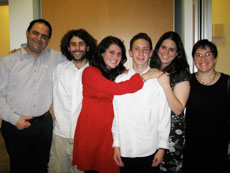 |
| Israel Sykes with his family |
Israel Sykes, who lives with his wife and four children in Jerusalem, made aliyah in 1980. An organizational consultant and “social entrepreneur” with a master’s degree in family therapy, he is dedicated to improving the lives of the disabled in Israel. He finds it interesting to look back at how he and his siblings were raised in Baltimore — their parents, prominent lawyers Judy and Melvin Sykes, are both Orthodox and liberal — and what they’ve become.
His two brothers are both still observant but much more politically conservative, while he has turned even farther to the left. He supports President Obama, identifies with the J Street lobbying group, and feels that Israel has not been fair to the Palestinians.
“Israelis have never really accepted the idea of a two-state solution,” he said. “Most Israelis feel that Arabs are all terrorists and can’t be trusted.”
For him, the most frustrating thing about living in Israel has been to witness “the growing distance between what Israel has become and what we had hoped it would be — a light unto the nations.”
Over the years, he has become increasingly disillusioned with the way things have gone politically. “I think that all populations, not just Jewish ones, should be treated fairly. We should be oriented toward a pluralistic society, one I can be proud of.”
Having now lived longer in Israel than he had in Baltimore, he doesn’t miss much about the city except, of course, for his parents.
Alan Baklor, originally from Stevenson, first came to Israel in the summer of 1985, and made aliyah two years later. He’d gone to Pikesville High, then Duke University. He’s currently employed at an Internet company (answers.com) in Jerusalem, where he lives with his wife and three children.
He considers himself “an ardent centrist” in both religion and politics. “I’ve always been bothered by the fact that Israel elections turn on only one issue [security],” and that too little attention is paid to things like education and jobs.
When Moshe Schechter comes back to Baltimore, he is always struck by “the aesthetic beauty of the Jewish community — what I miss most are the empty green spaces, front yards, back yards.” Then an optometrist, now a real estate syndicator, he came to Israel with his wife Vivien (nee Lieder) 25 years ago, on July 31, 1985. They have four children.
“Back then, you had to be a little nuts to move here,” he said. “Aliyah is not a rational decision — it’s an emotional one, from the heart. A friend from Baltimore once pulled me aside and said, ‘You don’t have to feel guilty about not living in Israel — just do what I do — write out a check!’
“I remember just before we left, I got a call from Rabbi [Herman N.] Neuberger of Ner Israel [Rabbinical College], thanking me for what I did to help the yeshiva. He said, ‘I admire your courage.’ I asked, ‘Do you admire my intelligence?’ He said, ‘I admire your courage.’”
The Schechters thought they had no illusions about what to expect — they accepted the idea that they’d always be Americans living in Israel — but they were not fully prepared either. “When we first got here, I ran into Rabbi [Samuel] Vitsick from Baltimore, and I told him how hard we were finding it to make the adjustment. He said, ‘If it were easy, then everybody would be doing it!’
He notes that it’s easier nowadays to make aliyah, but that the cost of real estate is very high — “like midtown Manhattan prices.’”
Yehiel Grossman, an accountant who lives in Ramat Bet Shemesh, went to the Talmudical Academy and Ner Israel; his wife, Faigy (nee Blumberg), to the Bais Yaakov School for Girls. They made aliyah for religious reasons, but they find life here to be “simpler, easier, more pleasurable.” Mr. Grossman walks two of his four kids (age 7, 5, 3 and 1) to school every day, then takes a bus to his office in Jerusalem — a 75-minute ride during which he often learns Talmud.
“It’s a mitzvah to live in Israel — and you feel closer to your roots here,” he said.
He misses his grandparents (Dorothy and Philip Grossman), but his two sisters (Rivki Segal and Vivi Mann) live in Israel with their families, and his parents (Irene and Steve) have an apartment in Jerusalem. All except his mother were born and raised in Baltimore.
Malkie and Aron Raskas made the move after their children were already older. They had lived in Baltimore for 22 years before deciding to start their lives over again in the Holy Land. He’s a lawyer who returns to his native city every five weeks or so to litigate for his firm, Kramon and Graham.
They live in Katamon, an upscale neighborhood of Jerusalem.
Malkie is a personal trainer and fitness expert; Aron plays soccer. Their son, Avi, who just turned 23 and recently married a Sabra, is active in a burgeoning flag-football league: some 60 teams play every Friday afternoon and Saturday evening at Kraft Field in Jerusalem, over a five-month season culminating with the Holyland Bowl in February. He’s captain of a team sponsored by Baltimore’s Tov Pizza.
Common Denominators
One doesn’t have to be married to make aliyah.
David Kozlofsky, 20, graduated from Yeshivat Rambam in 2007. He’d spent a summer here with a B’nai Akiva group, after which “I realized I wanted to have a life in Israel, be part of its future.” He’s currently a student in business economics at Bar-Ilan University.
So is Shoshana Pachino, 21. She likewise went to Rambam, came to Israel in 2006, and fell in love with the country. She made aliyah in 2008. “HaShem is giving us Israel on a silver platter — I felt it my duty to try to live here.” On Oct. 4, she married Moshe Rapps (originally from Teaneck, N.J.) in Israel; the young couple plan to live Jerusalem.
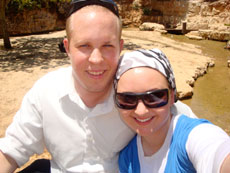 |
| Gavi and Elisheva Zeitlin are making a life together in the Holy Land.
|
There are many other Baltimoreans (too numerous to include in this article) currently living all over Israel.
They include Grace and Irving Abramowitz, Vivian and Bernie Auerbach, Scott Blumberg, Edie and Izzy Davidowitz, Devorah and Benjy Gasner, Rachel and Moshe Goldberg, Hadass and Levi Gordis, Miriam and Yitz Fischer, Sandy and Mitch Knisbacher, Devorah and Howie Klein, Risa and Noah Lasson, Tamar and Jeremy Lustman, Vivi and Rick Mann, Rivki and Yigal Segal, Arnie Taragin, and Debbie and Jerry Wolkenson.
Among them, there are common denominators. Virtually everyone interviewed said they missed family and friends, were often frustrated by Israeli bureaucracy — and all wished they still had the freedom of Sundays (a standard workday in Israel).
But they came to Israel, with all of its turmoil and toughness, maddening bureaucracy and scandal-plagued government. They’ve marveled at deserts made to bloom, at medical and scientific and technological achievements that belie the nation’s age, size and population. They came to what may be the world’s tiniest democracy, perhaps its most controversial, and certainly the one most taken to task for even the slightest of diplomatic or political infractions, whether real or imagined.
But most of all, infused with passion for this brave and spirited little country, they came to call it their own.
Kenneth Lasson is a law professor at the University of Baltimore. He directs the Haifa Summer Law Institute.
|


