|
There’s a few bumper stickers on Rabbi Elan Adler’s 1999 Windstar minivan near the “For Sale” sign. One reads, “Solidarity for Sderot.” The other, “Shalom Y’all.”
When the van’s new owner pulls the stickers off, it conjures up images of pulling a bandage off of a wound. Probably not the best use of a metaphor. In this case, however, this is all about that.
For so many in this community, Rabbi Adler has been the spiritual bandage we’ve all needed, sought and, in some ways, took for granted.
His July 6 departure for Israel, along with his dear wife, Dr. Rivkah Lambert Adler, and their daughter, is going to leave some of us in pain for a while. Oh, it will go away, sort of.
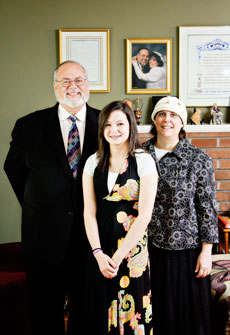 If anyone stepped forward to bring Jews together in this town, then it was this man, with the ever-present warmth and smile, who will be leaving on a Nefesh b’Nefesh flight early next month with his wife and daughter for their aliyah. If anyone stepped forward to bring Jews together in this town, then it was this man, with the ever-present warmth and smile, who will be leaving on a Nefesh b’Nefesh flight early next month with his wife and daughter for their aliyah.
Rabbi Adler used his good humor and solid, reassuring faith to bring this community together in so many different ways.
Indeed, one need look no further than his March 2001 installation at Moses Montefiore Anshe Emunah Hebrew Congregation to understand.
There, “the wide face of God,” as he calls it, brought out Sen. Benjamin L. Cardin (D-Md.), Rebbetzin Chana Weinberg, former NAACP president and congressman Kweisi Mfume, Rabbi Menachem Goldberger, Jewish communal leader Shoshana S. Cardin and William Cardinal Keeler, archbishop of the Baltimore Catholic Archdiocese.
No matter if one was black-hat Orthodox or unaffiliated or of a different faith, Rabbi Adler figured a way to make the parts fit together.
He was the spiritual leader of MMAE. But he was also a spiritual leader across our zip codes.
Here are the words of his friend and MMAE past president and current board chair, Bob Meyerson:
“Rabbi Adler is a gentle soul with an unbelievable and unique perspective on things. And the warmth? He is just phenomenal. We were lucky for 10 years to have him.”
Said close friend Dr. Kevin Ferentz: “Rabbi Adler has some unique properties that put him in a class of his own. First is his incredible sense of humor. We have been privileged to be at his Shabbos and yontif table many, many times, and I can honestly say I have never laughed harder than when Rabbi Adler was doing his impersonations. He has the quickest wit of anyone I’ve ever met.
“Next is his complete lack of being judgmental regarding fellow Jews. Rabbi Adler understands that we must love our fellow Jews, no matter where they are in their level of observance. Rabbi Adler also hugs harder than anyone I know. When he hugs you, you know you’ve been hugged. At his shul, when the Torah is carried around before and after krias hatorah, Rabbi Adler makes it a point to shake everyone’s hands and give them a kind word. And you know that he sincerely cares about every person he greets. He has a huge heart.”
Mr. Meyerson said in the spirit of love that there are probably 100,000 people in Israel who call themselves rabbi. What does Israel need with one more rabbi?
Yet, there is something about history and a person’s role.
MMAE was, for many, Rabbi Jacob A. Max’s shul. The former rabbi emeritus, who founded the shul more than 50 years ago, was convicted in April 2009 on charges related to sexual molestation. Still, there are many who love and remember what they consider the good things about Rabbi Max.
It was for Rabbi Adler one thing to come in after the legend cast by Rabbi Max. It was quite another to have to stand up on the bimah and tell his congregation last summer that Rabbi Max had yet to say he was sorry to anyone for his transgressions.
Perhaps in an odd way, what was Rabbi Max’s shul became Rabbi Adler’s shul. There was no one better to ease the pain of a congregation than the good-natured Rabbi Adler.
To carry it a step further, it was the week prior to Rosh Hashanah at a healing service for molestation survivors when Rabbi Adler stood before the community, offering words of support and almost apology on behalf of the rabbinate. Again, the bandage, the healing of the hurt.
“At a time when Rabbi Adler could easily have retreated from the controversy regarding Rabbi Max, he stood up and made apologies to those in the community that were harmed by Rabbi Max,” said Dr. Ferentz. “He made an effort to educate himself about the dynamics of sexual trauma by attending a training workshop for clergy. He was also the only rabbi to speak at (and one of only a few that attended) the Healing Service that was held to help support sexual abuse survivors in the community. Also … he is a great role model to show how to love and support your wife.”
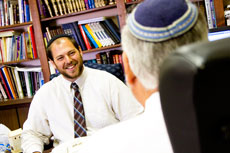 Rabbi Yerachmiel Shapiro, who succeeds Rabbi Adler at MMAE, praised him for his warmth and generosity of spirit. Rabbi Yerachmiel Shapiro, who succeeds Rabbi Adler at MMAE, praised him for his warmth and generosity of spirit.
“I’ve known him a short while but he’s been a tremendous mentor to me,” said Rabbi Shapiro. “He has a very big personality and the depth to follow that personality. It makes me feel like I have
a lofty goal ahead of me and I’m excited to achieve that goal.”
Inner Sabra
It was in 2002 that Rabbi Adler and his wife took a pilot trip to Israel. They would go ahead and purchase an apartment, and they looked ahead at someday living their lives there.
People in Baltimore and at MMAE were concerned that the family was going to get up and leave. Rabbi Adler, after all, is a sabra, a native Israeli. He joked that moving to Israel was “his inner sabra coming out.”
It was about a year ago that their oldest daughter finished seminary. Her question to her parents was, “I’m coming back to Baltimore for what?” It then became even more compelling for the family to move to Israel.
“All of the mountains [obstacles] melted before us,” said Rabbi Adler. “Everything we thought was insurmountable just melted. Everyone was compassionate and kind, especially the shul.”
There aren’t jobs pinned down yet for either the rabbi or Dr. Lambert Adler. He said he hopes to teach, to give shi’urim, parshah classes, and he calls it all a “big leap of faith that when I get there I’ll be presented with opportunities. I’ve got a lot of faith and confidence that once we get there, we’ll put a livelihood together. I’ve asked God for little signs that everything will be OK.”
Staying, however, wasn’t really an option for in many ways. Certainly, he would have kept his position at the shul. His congregants love him, the community respects and feels close to him. There was, however, something inside both he and his wife, a longing to be in the “Land” or Eretz Yisroel that sometimes can’t work through substitution.
“How long could we keep on going here,” he said. “We decided it was time to go.”
The hard part was, in many ways, less about the decision and more about what he called so accurately, “the disappointment tour.” This is how Rabbi Adler described what he and Dr. Lambert Adler had to do when telling family members, friends and congregants that they were going. In order, Rabbi Adler told his parents, his youngest daughter and then Mr. Meyerson.
“Look, he’s making aliyah,” said Mr. Meyerson. “Who can fault him? I just want to grab him and not let go. He’s taught us so much and meant so much to us. Look, there’s 100,000 rabbis over there. What are they going to do with one more? I hope that he will be accepted with his humanitarian ways. I hope he can just be himself there.”
The outpouring of emotion at his leaving has been overwhelming, the rabbi said.
“People have been very kind, very good,” he said. “I think a lot of people are happy that we are fulfilling our dream. I’m going to be with my peeps. This is where the whole Jewish community has its future. This process of leaving has been like tearing a Band-Aid off slowly.”
So what’s he going to miss?
Like a word association, “Dunkin’ Donuts” came first.
“I’ll miss my family and my friends,” he said, the serious tone returning to his voice. “And I’m going to miss having a place to practice what I think I’m good at doing. I’m a giver. I’ve got a lot to give.”
The rabbi’s office walls are covered with photos of people he’s met. There’s Al Gore’s onetime running mate Joe Lieberman, comedian Jackie Mason, former Gov. Robert Ehrlich, former Secretary of State Henry Kissinger and even Red Sox great Carl Yastrzemski.
He describes MMAE as a “place with little or no politics. It is a warm, loving, embracing place. We do b’nai mitzvoth for our member families and for the unaffiliated. We will treat you like you’ve been here for 50 years.”
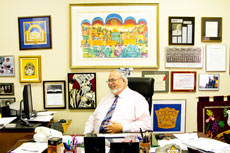 As Dr. Ferentz said, “Rabbi Adler has had a really positive effect on the Baltimore Jewish community. He is an Orthodox rabbi that is accessible and non-judgmental. He lives his Orthodoxy in a modern world and, because of that, he has been a role model to many people that have wanted to advance in their level of observance without retreating from the rest of the world. His being chosen as the first Orthodox rabbi to head the Baltimore Board of Rabbis is a testament to his inclusiveness. As Dr. Ferentz said, “Rabbi Adler has had a really positive effect on the Baltimore Jewish community. He is an Orthodox rabbi that is accessible and non-judgmental. He lives his Orthodoxy in a modern world and, because of that, he has been a role model to many people that have wanted to advance in their level of observance without retreating from the rest of the world. His being chosen as the first Orthodox rabbi to head the Baltimore Board of Rabbis is a testament to his inclusiveness.
“By making aliyah, while still at the height of his popularity, he is also making a statement to those of us in the diaspora that we should all more seriously consider making aliyah,” he added.
We miss him already, but had a few parting questions for him:
Is the American Jewish community in a good place right now?
Rabbi Adler: America has been extremely kind and supportive of its Jews, providing a haven and a place to flourish unimpeded. At the same time, I feel that except for certain Jewish communities in America, we are on a downturn, with assimilation, intermarriage, affiliation rates down, and a greater disconnect regarding Israel among young adults. It feels as though there is a tide of weakened Judaism that may be hard to reverse or to overcome, and perhaps spiritually American Jewry is in the midst of running its course.
Every Jewish exile, historically, runs its course, and maybe it’s happening quicker in our day so that Jewish people will take another look at living in Israel.
What about being a rabbi came as a surprise?
I was surprised that people loving you and appreciating you doesn’t necessarily lead to affiliating with you. I was surprised by how many factors go into the affiliation decision, besides loving the rabbi.
Were you comfortable being a bridge between the Orthodox and the Reform/Conservative communities?
I spoke this morning at the Cardin School graduation about my father, who has been an Orthodox Jew all of his life, and who taught at the Orthodox Providence Hebrew Day School for 28 years while he was the ritual director of the large Conservative Temple Emanuel for 36 years.
He loved and respected and valued every Jew. He was a bridge builder who remains beloved by both institutions and was awarded the highest honor at a dinner in each institution. I spoke at one dinner in his honor, explaining that the reason God was unhappy with the Tower of Babel is, because if people were going to use their skill to build something that huge, rather than build up, away from the people, they should have built across, bridging people.
The future of traditional shuls such as MMAE?
Though people often predict our eventual demise, we have grown by 100 families in the past 10 years. Our struggle to attract and maintain members is not that different from other synagogues. Our new rabbi and his rebbetzin have a great shot at reaching out to young families. Many of our current members have brought in new members, and we are a very happy and loving congregation.
How did you stay in tact in the Rabbi Max issue?
I stayed focused on all and any victims of sexual abuse. I was clear on what the synagogue had to do. I wouldn’t say it was a defining moment for me, thought it was a very trying time for all of us.
Defining moments for you at MMAE?
Becoming president of the Board of Rabbis in June of 2004 raised the profile and the stature of the shul with the first Orthodox president in 35 years, and the events that I attended and initiatives I began were nicely publicized in the media, which was great for the shul.
My friendship with Ed Miller, then one of three chiefs of staff for Governor Ehrlich. It brought Bob Ehrlich to our shul right before he took office after his trip to Israel to report to the community. I was also appointed by the governor first to the End of Life Issues Commission, from which I had to resign. They met on Fridays from 12 to 2. And to the Maryland Human Relations Commission. The governor’s visits and my appointments helped raise the profile of the shul.
When “Trembling Before God,” a movie about Orthodoxy and homosexuality, was shown at the Charles Theatre, director Simcha Dubowski invited several rabbis and rebbetzins to join him for a panel discussion following the movie. The place was packed with hundreds of people, and the only two rabbis and rebbetzins to show up were Rivkah and me, along with Simcha. It was a tough night, and it was seminal for me, because I knew I had to be there as a rabbi discussing a Jewish concern. I could not shy away.
While many were angry at the remarks I made — a combination of Orthodox views with compassion and stating again and again that there are much worse Jews than gay ones, so let’s put this in perspective — and looking at other things the Torah calls “toevah,” abomination, some of which are not sexual, many congratulated Rivkah and I for having the courage to be present and to speak.
On Kol Nidre night 2004, towards the end of my 11 pages on supporting Israel, I endorsed President Bush over John Kerry. There was healthy applause, as well as much discussion.
The sermon and endorsement ended up as the lead of an article in the Jewish Press the week following. This was seminal to me, in that I felt if a rabbi has something to say he ought to say it and take the punches, while at the same time, it made me more sensitive about remarks that potentially divide more than they lead, inspire or educate.”
|


