|
|
| North America: 1-866-4-ALIYAH • United Kingdom: 0800-075-7200 • Israel: 02-659-5800 |
|
 |
 |
|
|
Looking Back, Looking Ahead
By Rabbi Shalom Rosner
|
| |
|
|
|
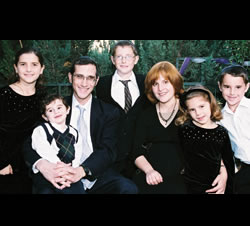
| The Rosner family in Bet Shemesh. |
|
|
|
|
|
Ten months ago, I, along with my family, had the z’chut of fulfilling a mitzvah that Moshe, Aharon, and Miriam could only dream of fulfilling. Coming down the steps off our Nefesh B’Nefesh chartered flight last August, we became part of a dream, part of something larger than ourselves, part of the national destiny of our people. We had come home. We had come to live in the homeland of our nation, the land which so many throughout our history had yearned, aspired, and hoped for. Now, we, standing on the shoulders of those who preceded us, had come back to our land. What a privilege, what a feeling, what a high.
Today, ten months after that fateful and awesome day, we look back to see what we have accomplished, where we stand, and where we aspire to go—both personally and communally. Personally, I am reminded of a thought by Rav Yitzchak Hutner. He noted that in Hebrew, the word “modeh” has two meanings: to thank, as in “Todah rabbah”; and also to admit, as in “modeh b’miktzat.” What is the connection between these two meanings? Rav Hutner suggested that the first step in giving thanks is to admit and recognize the tremendous gift given. Once I admit to that, and recognize that it doesn’t all come from me, then I am able to give thanks to the giver.
We use both of these meanings each time we daven. “Modim anachnu Lach—we admit to You,” “she’Attah hu Hashem Elokeinu—that you are our G-d,” You are the source of all our blessing. Only then do we say, “Nodeh lecha u’nsapeir t’hilasecha, al chayeinu,” Thank You for giving us life, for giving us our neshamah.
My wife and I recognize the tremendous siyatta d’Shmaya that Hashem, along with His shalichim, has given us throughout our move. The services of Misrad HaKlittah, along with the constant support of the Nefesh B’Nefesh staff, make the landing that much softer for all olim. What other country pays for your flight and gives you several months of financial help, in order to help get you on your feet? It certainly is not the same welcome that Avraham Avinu received upon reaching Eretz Canaan.
The kids are acclimating, and continue to adjust. Of course, every child is in their own respective situation, with the ups and downs that are to be expected in a new country, with a new school system, a new group of friends, and a new language to learn. But on the whole, it has been a tremendous berachah, a wonderful experience for all. Each of them has a great chevrah, they are understanding more and more with the daily ulpan help they receive, and they are slowly losing the feeling of being olim chadashim.
They are not even conscious of some of the magic which they are experiencing. When my six-year-old, Naama, takes an apple from the fridge and asks innocently, “Does it have kedushah?” it gives me goose bumps. When, during Tishrei, my 5th- and 7th-graders each have midnight walks in Jerusalem’s Old City, walking on the same hallowed ground as the great Biblical and Talmudic figures, Dovid and Shlomo, followed by Shammai and Hillel, culminating with saying Selichot at the Kotel, it helps me understand what it was that made me uproot a comfortable Five Towns family and move them across the world to start a new stage in their collective lives.
When, on Friday afternoon, we finish our Shabbat preparations early and then drive 15 minutes to take a quick pre-Shabbat tiyul, to grab a glimpse of where Dovid haMelech felled the giant Golyat, we realize just how special is this land in which we live. So yes, we admit and recognize the gift that Hashem has given us, and thank Him for the opportunity to be part of our ongoing national history and destiny.
On a communal level, as I think of our fledgling Nofei Hashemesh community, as well as Eretz Yisrael in general, I take note of a thought of Rav Zevin, mentioned at the end of Sefer Sh’mos. The consecutive parashiyos of Vayakhel and Pekudei are usually read together. Rav Zevin remarks that there are many who believe in the strength of the tzibbur, the collective effort. It’s all about the team, and individuals lose their own identity. The sum wipes out the value of any of the combined parts. There are others, though, who believe in the strength of the yachid, the ability of each person to strive, to succeed, and to make an impact. The greatness of a group is the specific parts within.
Yahadut does not accept either extreme. We believe that a tzibbur, a kehillah, is an entity that achieves goals and attainments that would not have been possible by any individual yachid. The collective is greater than the sum of its parts; but that does not diminish the uniqueness, value, and importance of the contribution of each of the members. We believe in Vayakhel, the kehillah, the group, as well as Pekudei, the pekudah of each person, the special position and abilities of each and every individual. Vayakhel and Pekudei go together.
Eretz Yisrael is one large kehillah, where every Jew feels that they are part of something larger than themselves—a national family, representing the Jewish people in the eyes of the world—while never losing sight of the fact that each and every person contributes to that greater society. At our Nefesh B’Nefesh welcome celebration, Binyamin Netanyahu told us, “There are many challenges and complexities in this land, but always remember that it’s your land! That cannot be said about any other country in the world. Each of you has the chance and privilege to make a difference, affect your surroundings, and make this great country an even better place.”
On a personal note, our Nofei Hashemesh community/shul has, baruch Hashem, taken off and grown. We have Shabbat minyanim, with about 50–60 attendees each week. We have a board and a sisterhood, which care for all the needs of the shul. Daily daf yomi and weekly parashah and halachah shiurim are well attended (and are uploaded to www.projectsinai.org and www.yutorah.org, respectively). We have had an amazing year, spanning the Yamim Nora’im to a Chanukah concert, a children’s Megillah reading to shul matzah-baking, a Lag Ba’Omer medurah to an all-night learning program on Shavuos.
Coming down our block at about four o’clock every afternoon, one is greeted to a bungalow-colony atmosphere—kids playing outside, parents schmoozing on the side. Though we pray for rain in the winter months, the mild weather has allowed our children to play outside throughout the school year. One feels at home. My wife and I feel so fortunate to be living with such amazing families as those who have moved in with us. Each one adds so much to the lives of the others. We invite all of you to come share a Shabbat in our community and in our shul.
A climax for our family was our son Yehoshua’s bar mitzvah, which took place in the shul on Parashat Sh’lach. It really felt like a dream, being zocheh to celebrate this milestone in the land which so many Jews throughout the generations yearned even to just catch a glimpse of. It really seemed like siyatta d’Shmaya that our Yehoshua had the parashah of Sh’lach, the parashah about the uniqueness of Eretz Yisrael. Had we still lived in Woodmere, his parashah would have been Beha’alosecha!
One comment about our new home, the larger Bet Shemesh community: Since the moment we arrived, we have been welcomed with open arms, and we have found Bet Shemesh to be a great place for new olim. From a fridge personally delivered upon our arrival (by a stranger who happened to hear that we were in need), to Shabbat play dates set up for each of our children; from the daily ulpan services provided by the iriyah, to the public pool, with daily separate hours, providing for all our needs; from the beautiful landscape of mountains and sheep that we see outside our window, to the reality that we are a half-hour drive from the Makom haMikdash, we are proud and grateful that we have chosen Bet Shemesh as our home. Of course, there are challenges—as there are in every community in the world—but we are thrilled to be part of this wonderful Torani community.
One final personal note. Obviously, aliyah is a major decision, which impacts all areas of our family’s life. But after being here for only ten months (and all the vatikim can say this with even more conviction), I realize that every Jew really only has one home. And the more you live here, the more you feel that way. Every oleh has various stories about their first year, dealing with schools, offices, banks, or driver’s licenses. But so many of our stories reflect the fact, and reinforced it in me, that I am now home. Some examples:
• Last month as I was on my way to giving a shiur in Yeshivat Shaalvim, the taxi driver, upon hearing that I was going to give a shiur, asked me—or rather, demanded from me—to give him a preview rendition.
• Each Friday, at the end of the regular “secular” news, wishes of “Shabbat Shalom” and a reminder of the time of candle lighting is broadcast throughout the country.
• When my wife and I took our driving tests, the 80-year-old instructor told us to bring our infant along, because “No problem; I will babysit while you go take your tests.”
• After my wife and I hosted a post-Chanukah game night (where we played Israel Jeopardy and Aliyah Password) in our home, we all packed up the leftover baked goods and they were brought the next morning to soldiers at the Gaza border, to give them encouragement and make sure they realize that we are with them during the war.
• After the last bechinah that I gave in my yeshiva, Yeshivat Reishit Yerushalayim, I took my talmidim on a tiyul—not to Yankee Stadium or Chelsea Piers (previous destinations of my shiur outings), but to the Old City of Yerushalayim, visiting almost every one of its magnificent gates.
Yes, I felt very fulfilled in my previous stage of life, and I have tremendous hakarat ha’tov to the institutions with which I was involved. But living in Israel, and being involved in teaching in both a yeshiva and a community setting in the land of our Avot, has been on a different plane. As I said before, as any oleh would tell you, one feels that he has come home.
Our challenge now can best be summed up with the words of the Kotzker Rebbe. He notes that the pasuk at the end of Mishpatim (Sh’mos 24:12) states, “Va’yomer Hashem el Moshe, ‘Aleih Eilai, ha’harah, vehyeih sham’—Hashem said to Moshe, ‘Ascend to Me, to the mountain, and be there!’” What does G-d mean that he should go up the mountain and be there? Of course, once you climb the mountain, you will be at the top! The Kotzker answers no, it’s much deeper. One can be on the mountain, and really not be on the mountain. One can go to a shiur physically, but not really be at the shiur. The challenge of every Jew is to not only get to the place, to go up the mountain, but to also be on the mountain, to experience the mountain, to get the most out of the experience of the mountain.
Hashem says, “Moshe, don’t just climb Har Sinai, but be on Har Sinai; get the most out of Har Sinai that you can get!” After one makes aliyah, the challenge is to keep striving, keep growing, to not feel that it’s enough just to be in this special land, but to keep going to even greater heights.
Eretz Yisrael is our land, the special gift that Hashem has given to His people, the land in which one feels closer to Hashem. Let us appreciate its qualities, recognize its beauty, and yearn for the day that all the Jewish people will be living within its borders.
|
|
|
|
|
|