Far from the charming thatched cottages and verdant valleys
of her native country, Malka Liss sits in a noisy coffee shop
in sun-baked Jerusalem. During the brief hours between her
college studies and her job cleaning houses, she traces the
steps in her decision to leave one small land for another.
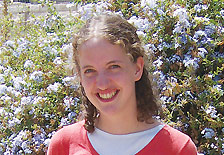
Feels like home. 'Here's where I'm meant to be. This is
what I want for me and for my children,' says Malka
Liss.
Photo: Abigail Klein
FAMILY BACKGROUND
Growing up in a traditional Jewish home, Liss attended
Sunday school until bat mitzva age. Though Cardiff, the
capital, is the largest city in Wales, its 320,000 inhabitants
include only about 200 Jewish households.
"There were eight people my age in my heder class,"
says Liss with a smile, "and one of them was my twin brother
Joshua."
Her father had lived in Israel for a few years, and he
wanted his three children - including Sarah, now 22 - to have
exposure to Zionist ideals. So the Liss kids all went to
England to attend Bnei Akiva camps when they were teenagers.
"In Bnei Akiva, aliya is one of the main values they push,"
says Liss. When she came to study at Midreshet Harova in
Jerusalem after high school, she was already thinking about
aliya. "Both of my siblings did the same. I think it's very
hard for parents when their children leave, but they're very
proud of us all."
ARRIVAL
Liss stayed at Harova for three semesters, going back to
Wales in March 2007 to prepare for the move.
"There is no shaliah [aliya representative] in
Wales, so I had to drive three or four hours to London to file
my paperwork, but only once," she says. "I was able to do most
things over the phone and while I was here studying."
Liss booked a seat on a Nefesh B'Nefesh group flight in
July from London, along with a friend from Scotland and about
50 other new olim.
Because her brother Joshua was then serving in the IDF as
part of the Mahal program for non-citizens, and Sarah had
already made aliya, the Liss siblings caught the attention of
the Welsh BBC. In the months leading up to Malka Liss's
departure for Tel Aviv, a crew started filming a documentary,
"O Flaen Dy Lygaid: I Wlad Yr Addewid" ("In Front of
Your Eyes: To the Promised Land").
"They shadowed me beforehand and a reporter came on the
flight with me. After we landed, they hired an Israeli
cameraman and filmed us all a few more times." The documentary
aired last December.
After arriving, Liss was headed to the Beit Canada
absorption center in Jerusalem, but took a detour to accompany
her Scottish traveling companion to an acquaintance's home.
"Her friend had already gone to sleep and she couldn't get
into the house and we didn't know what to do," recalls Liss.
"We were calling everyone in the middle of the night and
nobody was answering."
After that rocky start, she made her way to the absorption
center in the wee hours, but stayed there just one month
because she found it lonely. "I moved to Midreshet Harova and
lived in an apartment as a graduate with some other girls. It
was a nice apartment and a good environment. I worked in the
kitchen there."
DAILY LIFE
Liss studied in Ulpan Beit Ha'am for five months,
babysitting in the afternoons to augment her income. Then,
following in the footsteps of her sister, who is studying
optometry at Hadassah College, Liss enrolled in Taka, a
special course for new immigrants at the same Jerusalem
college. She moved from Harova to a dorm room in the Baka
neighborhood on July 1.
"I'm studying Hebrew, statistics and computers," Liss says.
"In the fall, I will be starting a three-and-a-half-year
occupational therapy program in Bnei Brak. But I hope to come
back to Jerusalem afterward."
She is financially independent, priding herself on the fact
that she has never yet felt the need to ask her parents for
assistance. "I was brought up to be very self-sufficient and
that helped me," she says. She also is grateful for the
first-year benefits for new immigrant that are offered from
the Ministry of Immigrant Absorption.
THOUGHTS ON ALIYA
Liss readily admits that she's grown nostalgic for aspects
of life in Cardiff, although that has not lessened her love of
Israel.
"I'm very happy that I moved here. I know that in the long
term this is where I want to live. But now that I've been here
a year, and realize I will be here forever, I miss some things
about Wales. It's a very green and beautiful country with
lovely hills and valleys. My father likes houses, and we used
to take walks and look at the houses. Living in Baka is a bit
fun because of the old houses, although they are very
different."
Mostly, however, she revels in the things she was never
able to enjoy in Wales. "There was not one kosher restaurant,"
she says. "There was one shop that opens once a week for
kosher food. Now I don't have to walk an hour to get to shul.
And all my friends are here."
In addition, she feels that her practice of Judaism has
taken on new dimensions since coming here to study.
"Before I came to Harova, I didn't have the foundation in
emuna [faith] and mahshava [philosophical
thought], the things that make you a Jew apart from Halacha,"
says Liss. "I think there's a big difference in how you
practice Judaism outside of Israel. We never learned the
reasons we do things. Something was missing."
THE ADJUSTMENT
"The most difficult part is my struggle with the language,"
says Liss. "I know I will have to study in Hebrew, and it will
be so hard.
"Before I made aliya, everyone encouraged me but didn't
explain that when you make aliya without your family, you're
here alone and you don't have your parents' home to go to. You
don't have them here to help you. For instance, I just moved
and I didn't have their car available to me."
She advises others in her position not to hesitate to move
to Israel, but to realize the implications of coming solo.
"Make sure you get numbers of people to go to for Shabbos, and
get yourself a group of friends. If you have friends in Israel
already, keep in touch with them before you come because your
friends become your family. But you have to have the
confidence to call random people and ask for help."



