Among
the 235 Americans who arrived on Monday aboard the Nefesh B'Nefesh
flight from New York was nurse practitioner Harriet Mark, a former
lieutenant-colonel in the US Air Force reserves. After the September 11
attacks seven years ago, she was recalled to active duty and sent to work at Ground Zero for three weeks.
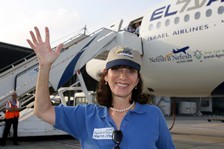
Harriet Mark arrives at Ben Gurion Airport on Monday.
Photo: Nefesh B'Nefesh
Mark
served as the executive officer, second in command of critical-incident
stress management, there to support rescue personnel who saw terrible
things and needed psychiatric help. She prevented a lot of potential
suicides. She described her role as providing medical support -
assessing the rescue workers, and treating them on the spot. If they
needed more help, Mark transferred them to a place where they could get
it.
"I practiced my trade, wrote prescriptions and diagnosed. At
that time, it was two weeks after the event. No longer a rescue
mission, now it became a recovery mission. There was a big pile. That's
where the actual buildings went down," she told The Jerusalem Post on Wednesday.
"There was a possibility that there were people in there. New
York hospitals were ready for many wounded, but didn't get it, mostly
deaths. We were taking care of the recovery people, the policeman and
fireman cleaning up the area, because it was very gruesome work.
"When they found a body part, they would walk a
stretcher out like a funeral. It was very solemn, sad, but encouraging
because somebody's relative was found. It would give the family some
closure on losing a loved one in a terrorist attack.
"It would affect anyone to work there. It's hard to see anybody suffer.
"My
son worked two blocks away. I didn't know if his building was hit or
[would be] next. Until you hear from a person in the area, your world
stands still. I'll never forget. Thank God, my son is safe. After the
work that I did, having experienced it myself, I knew how many people
didn't get the good news I did.
"While working we had to wear respirators because the air was
toxic. It was hard to talk, it was exhausting. The nurses stayed on
Governors Island and took a ferry over, we all slept there. Starting
off early in the morning, we talked to members of every military
branch. My job was really walking around with a backpack full of
medical supplies and communication equipment.
"If the rescue worker looked suicidal, there was a
protocol. If they were hungry or thirsty, I made sure that they were
fed and taking proper rest cycles. People just wanted to work and work, it was frenzied. They weren't taking care of their own health," Mark said.
Mark described the general reaction of Israelis to the World Trade Center attack as, "Now they [Americans] can understand."
It was now easier to speak to Americans about terrorism
and the Israeli experience, she said. Mark encourages these people to
ask themselves: "Did the woman who sat and typed do anything bad? Did
the cafeteria worker deserve to be blown up?"
Mark retired a year and a half ago from the US Air Force Reserves. She keeps in touch with those she worked with at Ground Zero.
"Sometimes we e-mail each other. We used to always go to
the base and have a commemoration. Now that I'm no longer active, I
have to to do this for myself."
Mark had been dreaming of moving to Israel for many years.
There was always a reason to postpone her aliya, with six grandchildren
divided between the two countries. She joins her son here; he made
aliya with Nefesh B'Nefesh in 2004.
When asked about balancing her national identity, she
explained that "America has been very good to me, and to my family.
American jobs helped me be able to come here. Year after year, it was
tiresome to explain my traditions and be surrounded by secularism. I want to be around my people and celebrate my holidays. I want a meaningful life, which I didn't have in America. I love it here."



