FRAMINGHAM - Most people David
Tatarinov-Levin's age have spent the past few weeks getting settled on
a college campus, preparing for four years of study, and socializing.
But the 19-year-old from Framingham felt a call to do something else.
He
felt his homeland calling, he said, and decided to become one of the
youngest Americans this summer to "make 'aliyah,' " which in Hebrew
means to ascend, or immigrate, to Israel.
Tatarinov-Levin plans
to join the Israeli army, and could face hazardous duty in a region
constantly battling terrorist attacks and hostilities with its
neighbors. His choice to serve in the military now and pursue college
later comes from a difficult-to-describe "ideological" gut feeling, he
said.
"I feel like this is my path. It's not that I am so in love
with army life or shooting guns," Tatarinov-Levin said in an interview
at his family's home in Framingham's Saxonville section during a break
from packing his bags, a few days before his flight last month to Tel
Aviv. "But I am physically and mentally prepared to serve the country
now, and I want to do it now."
Once considered by most mainstream
US Jews to be a somewhat fringe act - to abandon an American lifestyle
on the basis of the Zionist concept that all Jews are entitled to
receive help relocating to their homeland - the practice of making
aliyah continues to grow in popularity, despite the upheaval in the
Middle East.
Tatarinov-Levin was among 300 American Jews who
converged at JFK International Airport for the Aug. 18 flight chartered
by Nefesh B'Nefesh, a Jerusalem-based philanthropic group that says it
has helped sponsor nearly 16,000 North American Jews moving to Israel
over the past six years.
All Nefesh flights are a mitzvah - or
joyful blessing - but last month's was especially exciting, said the
organization's spokesman, Charlie Levine.
Among the emigres
aboard the El Al flight were a newly married couple who called upon
other passengers to help them celebrate one of the traditional seven
nights of blessings.
Also along was Frances Greenberg, an
88-year-old Holocaust survivor from Germany who was aboard the famous
"Exodus" ship that was turned away from Palestine by a British naval
blockade in 1947. After she was deported back to Europe, she immigrated
to the United States.
Of the 2,000 Jews who are moving to Israel
with Nefesh this year, nearly 100 young men and women will, like
Tatarinov-Levin, join the Israeli Defense Forces, Levine said. A
special program to recruit medical personnel has added 90 doctors to
staff Israeli clinics and hospitals over the past few years.
Alongside
Tatarinov-Levin and Greenberg was 26-year-old Bethany Sarota of
Watertown. A recent graduate of Suffolk Law School, Sarota, who goes by
her Hebrew name, Batya, had been considering the move after several
stints in Israel with a program that allowed her to explore her
heritage as an African-American and Jew.
In a telephone interview from her new home in Tel Aviv last week, Sarota described an exhilarating and difficult adjustment to Israeli language, culture, and economy. A week after arriving, she misplaced her bank card accessing her US accounts, and because of the Labor Day holiday spent days unable to contact anyone to unblock her funds.
She turned to shopping in the city's open-air markets for bargains (fortunately, schnitzel, hummus, bread, and fruit could be had for a handful of coins, she said).
"It was the most humbling experience to be separated from my money, because I had to connect that I was really an Israeli and had to let go of my American life mode. I had to pinch every shekel," she said. "You can prepare as much as possible for a new life, but it's still a culture shock."
Sarota said her parents, who are both Jewish, were "very supportive" of her decision to make aliyah. "It honored what they wanted for me and what I wanted for myself."
Seeing a child possibly heading into harm's way was harder for Tatarinov-Levin's mother, Tamara, who came to the United States from Ukraine in 1981 and works for the city of Cambridge. She wishes her youngest son would not leave home to serve in the military, or would at least earn a college degree first. "I don't want him to fight and I don't want him to be part of the government," she said.
But interest among Jews in fulfilling what some consider to be one of the most sacred religious acts seems to be booming. Another 20,000 hopeful emigres from the United States and Canada reportedly are in the Nefesh B'Nefesh pipeline for travel to Israel in the next five years. The agency, which spends $7 million annually on grants and assistance programs, was buoyed this year by a grant of several million dollars from the Israeli government, Levine said.
The program places Israeli bureaucrats on the chartered airline flights, so participants get much of their tedious immigration paperwork completed while still in transit. The program also offers housing assistance, job and language training, and school relocation services, as well as grants ranging from $7,000 for individuals to $20,000 for the largest families. When each aliyah flight lands, travelers are met with fanfare and a delegation of government leaders. "They feel like rock stars," spokesman Levine quipped.
Intense counseling efforts have made the numbers of successful relocations skyrocket from a five-year retention rate of 50 percent in the 1970s and 1980s - when many Americans were unable to adjust to Israeli life and returned to the United States (or "yerida," Hebrew for descent) - to more than 90 percent today, Levine estimated. Now, just a few Nefesh-sponsored families abandon Israel for the United States each year, generally for health reasons, he said.
"The concept has really become part of mainstream American Judaism; you won't find a rabbi or Jewish community leader today who thinks it's odd or a fringe thing to do anymore," said Levine, a Texas native who made aliyah in 1978 at age 26.
The last Nefesh B'Nefesh flight of the summer took off Sunday carrying 300 hopefuls, including Diana Vladimirovna Pyatov, 32, of Cambridge. Pyatov said she hopes to earn a master's degree in art education and settle in the Haifa region of Israel.
The child of Russian-Jewish immigrants, she had wanted to make aliyah for nearly eight years, and planned to concentrate on intensive Hebrew classes as her first entry into the culture.
"I am so nervous and excited," she said in a phone interview shortly before her departure. "I feel like the most important part of my life is about to unfold."
Matters of Faith is a series of occasional articles examining religious life in area communities.

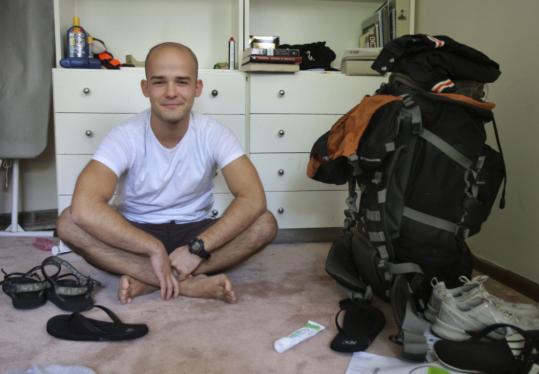 David Tatarinov-Levin said goodbye to Framingham to serve in the Israeli army.
(Suzanne Kreiter/Globe Staff)
David Tatarinov-Levin said goodbye to Framingham to serve in the Israeli army.
(Suzanne Kreiter/Globe Staff) 

