|/nbncoil/site/Scripts/AC_RunActiveContent.js" type="text/javascript">
logo Home  |  About  |  Services  |  Media Room  |  Site Map  |  FAQ  |  Donate  |  Contact  |  Business Directory  |   עברית
  North America: 1-866-4-ALIYAH United Kingdom: 0800-075-7200 Israel: 02-659-5800  


Haaretz israel news English
Published: 5 Elul 5768, September 5, 2008
Link to original article


Jerusalem and Babylon / The Jewish Agency's diminished role
By Anshel Pfeffer


Last week, the Jewish Agency signed its own death certificate. The agreement with Nefesh B'Nefesh (NBN), the private organization that has been helping thousands of Jews immigrate from the United States and Canada, whereby the agency will cease its aliyah operations in North America and NBN will become the only address for those thinking of making the plunge, means that the agency is relinquishing its main historic mission in the world's largest Jewish community. It also embodies the fundamental change in the relationship between Israel and the Diaspora.

In the press releases that announced the end of lengthy negotiations and a bitter rivalry of at least two years between the two organizations, the agency emphasized that it would continue being the sole authority responsible for determining the eligibility of potential immigrants for Israeli citizenship - in that way it would maintain its involvement in the aliyah process. But this is little more than a clerical function that certainly does not necessitate a large operation.

So why did the Jewish Agency give up on aliyah? Not with great joy, certainly. It took a long struggle against NBN, with mutual slurs and spanners thrown into the works, and even now, the agency is insistent that aliyah is still at the top of its agenda. But finally the venerable organization understood that it was inevitable. For the past few years, about 18,000 immigrants have been arriving annually, and even that will go down next year now that the government has decided to bring no more Falashmura from Ethiopia.
Advertisement
There is almost no more aliyah "in distress." A few thousand continue to emigrate each year from the former Soviet Union - almost all those who desired already came in the big aliyah waves of the 1990s. In Russia, Ukraine and the other republics, new and renewed communities are springing up with young, educated and affluent members who want some kind of Jewish life, love Israel, but are very comfortable staying where they are. Over 90 percent of the world's Jews live in the rich countries of the West, and even those who live in less salubrious surroundings don't see Israel as the ultimate refuge.

Only a handful of the 20,000 Jews of Iran have taken the opportunity to leave the land of the Ayatollahs. Tens of thousands of Jews emigrated over the last decade or so from South Africa, but the great majority just hopped over the Indian Ocean and settled down in Australia. Even in war-torn Georgia there are no signs of a stampede for the airport.

The Jewish Agency and other government departments concerned with bringing and absorbing olim have not turned a blind eye to these trends. Resources were shifted toward the largest concentration of potential immigrants in the world: North America. The term "aliyah from choice" was coined and packages of economic incentives were prepared to make Israel more attractive to the typical Jewish bourgeoisie. But the Jewish Agency and Ministry of Immigrant Absorption are not financial giants - their budgets are insufficient to transform Israel into a more profitable environment for members of the upper-middle class in the world's wealthiest countries.

For the agency, which is struggling with a $30 million deficit and conflicting demands from its big overseas donors, it proved impossible to compete with the public relations offensive of NBN, which every few weeks generates a blaze of publicity by bringing a specially-chartered Boeing on a direct flight from JFK packed with new olim. In a few short years, the new organization has set up a slick Web-based operation, providing up-to-date information to prospective immigrants, coordinating housing and employment solutions, providing guidance throughout the process before and after arriving in Israel, and, of course, a significant grant.

Despite all the hype, though, there are not any signs of a major aliyah push from America. At most an additional thousand or two each year - meaningless against the backdrop of at least 6 or 7 million Jews who still live there. It's not even clear how many of those who arrive under the auspices of NBN did so because of the organization's efforts, and how many would have emigrated anyway.

The agency didn't find it easy giving up its aliyah hegemony. Just a year ago, Chairman Zeev Bielski was still trying to oppose the government's decision to award handouts to the private aliyah organizations from its permanent budget. But most of the agency's leaders understand by now that if the organization wants to be reborn as a relevant body, it has to focus on education and use its budget, which is derived anyway from the largesse of Diaspora Jews, on fostering Jewish identity among the younger generation.

The apparatus of aliyah emissaries cannot deliver results anymore, and will have to be dismantled. The political leadership has also reached this conclusion. Prime Minister Ehud Olmert's speech three months ago to the agency's board of governors showed the way when he said that Israel must stop seeing in the world's Jews merely a source of donations and manpower, and start assuming responsibility for the future of communities, even if their members aren't planning right now to emigrate.

Even Ariel Sharon's most ardent acolytes have realized that his orders to bring a million olim over the next decade were unfounded. Neither the Jewish Agency nor the private organizations will succeed in bringing even one quarter of this number; they simply don't want to come. Even those who continue to see the immigration of Jews to Israel as a supreme value are beginning to conclude that Israel must behave like other developed countries that want to attract educated and productive immigrants, and focus on attempts to improve the local economy so that Israel will become a reasonable or even preferred alternative.

Mass immigration is no longer a national mission. Though Israel is committed to maintaining its ability to absorb large numbers of Jews in a time of emergency should one occur, in the meantime, instead of continuing to pay lip service to the immigration of Jews, it must focus the majority of its efforts on building an Israeli society that benefits all of its inhabitants: veteran, new and future.

Ulpan students who were hoping to return to their studies after the summer break may find they have no classes to return to, after Education Ministry Director-General Shlomit Amihai instructed that no Continued Ulpan classes be opened this academic year. This decision follows an eight-month battle between the Education Ministry and ulpan teachers over how to deal with a 38-percent cut in the ulpan budget.
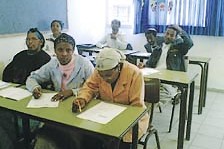
Ethiopian ulpan students

Ethiopian ulpan students
Photo: Courtesy, Gali Zadik

But are five months of Hebrew lessons enough for a new immigrant?

Continued Ulpan

According to the new system, the Education Ministry will continue subsidizing the first 500 hours (five months) of a new immigrant's Hebrew studies, Ulpan Aleph (First Ulpan). It will no longer subsidize ulpan studies, known as Ulpan Hemshech (Continued Ulpan), beyond that initial period, except for specialized programs for certain groups.

"Hebrew is not something you can measure in months. [Immigrants] come with different levels and certain people learn quicker than others," Danny Pins, the Director of the Division of Immigrants and Integration of the Joint Distribution Committee in Israel, told Metro.

"For certain people [five months] is wonderful and for other people it's only the beginning," he added.

According to Gali Zadik, an ulpan teacher in Kiryat Yam and head of the Teachers' Campaign Group which participated in Knesset debates on the ulpan issue, new immigrants need more than just basic language tools to properly integrate into society. Immigrants don't just need to get by in shops and restaurants; they need to find and keep employment, converse with their children's teachers, negotiate housing contracts, explain electrical problems to mechanics, make friends - the list is endless.

The entrance to Ulpan Etzion.

The entrance to Ulpan Etzion.
Photo: Gil Zohar

Nir Topper, adviser to the director-general of the Education Ministry, admits that the ministry knows 500 hours of language instruction is not enough to equip anyone to learn a new language and go out and find a job. But the ministry is working within the limits of a budget, he explains. It has re-ordered its priorities and decided that the most important ulpan population is the newest immigrants, those who have most recently arrived.

"The first goal is to help [new immigrants] find their place - geographically and mentally. If the budget [increased], maybe there would be an opportunity to open Continued Ulpans, but right now, when the minister needs to find a place to cut, this is the place," he told Metro.

Pins said that if the authorities were "a little more creative," additional classes could be made available, either via a full-fee-for-service arrangement or a partial subsidy. Ulpan Ra'anana, for example, has until now charged NIS 55 for two months of studies - approximately 182 hours, but has been ordered by the Education Ministry to completely cut off Continued Ulpan.

Other institutions however, such as universities, charge "a lot of money," Pins said, and their intensive courses are only offered at certain times of the year. The Hebrew Studies Center at Tel Aviv University charges immigrants $1,200 for its intensive seven-week summer course, which comprises approximately 175 hours.

Avi Silverman, Adviser for Education and Communities at Nefesh B'Nefesh, suggests that Continued Ulpan be offered for a nominal fee, "something that was not hundreds of shekels per month." Silverman suggests that private tutors could be offered in areas where there are insufficient students to warrant creating an entire class. Nefesh B'Nefesh has also put together a list of online resources, including online group classes.

But at least as far as the Education Ministry is concerned, education as part of Continued Ulpan was a for-free service. Ministry spokeswoman Pnina Ben-Shalom explained how "up until now, any fees that Continued Ulpan students paid ulpans went to the local authorities or the operating bodies, and not to the Education Ministry."

The ministry is considering whether to provide Continued Ulpan for a fee, but a nominal payment may not be enough to cover the costs of the classes. Also, low demand in a particular region may not justify opening a new class. In that case, immigrants could potentially continue studying as members of existing First Ulpan classes. The Education Ministry did not state whether this would be permitted under the new system, though it said that students who have finished five months of ulpan have attained a higher level of of facility in Hebrew than First Ulpan students and cannot continue to study with them.

However, because ulpans offer numerous language levels in First Ulpan studies, this may not be the case.

The Education Ministry recognizes the importance of providing immigrants with the Hebrew they need in order to work and will continue to provide specialist Continued Ulpan programs according to demand, including ulpan for accountants, bookkeepers, lawyers, courtroom typists, medical and pre-medical professionals, police force candidates and bus drivers.

In addition, some municipalities, such as Tel Aviv, Jerusalem and Netanya, are implementing Continued Ulpan frameworks for their new immigrant populations, Ben-Shalom said.

The ministry has also said that regular Continued Ulpan classes that were running as of January 3, 2008, could continue running until their scheduled conclusion. There will also be no changes to Continued Ulpan for Ethiopian and disabled immigrants.

10 years down to 18 months

Until now, immigrants have had 10 years in which to exercise their entitlement to 500 hours of subsidized First Ulpan. That gave them time to find a house, put their children in school and get established in the country before committing themselves to full-time study.

The new system, says Topper, will return to the original set of regulations set by the Education Ministry. Immigrants will now have 18 months to exercise their First Ulpan entitlement.

Pins, however, points out that for some people, getting off the plane and studying Hebrew right away is not effective. "They're processing so many other things," he said. Studying Hebrew should be an ongoing opportunity... whether they just arrived or whether they've been in Israel for several years."


Israel: Beit Ofer - 5 Nachum Hefzadi • Jerusalem, 95484 Israel • Tel: 02-659-5800
North America: 42 East 69th St • New York, NY 10021 • Tel: 1-866-4-ALIYAH
United Kingdom: JNF House: Spring Villa Park • Edgware, Middx HA8 7ED, UK • Tel: 0800-075-7200
Copyright 2002 - 2009 Nefesh B'Nefesh. All Rights Reserved.

Nefesh B'Nefesh Legal Disclaimer - Click Here
