It would be a mistake to view the agreement announced on Sunday between the Jewish Agency and Nefesh B'Nefesh to cede aliya promotion in North America to the smaller organization as a mere logistical arrangement, as Jewish Agency spokespeople have claimed in recent days.
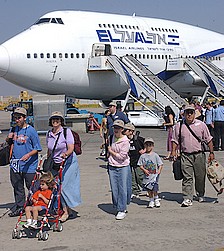
American Jews make aliya (illustrative)
Photo: Ariel Jerozolimski [file]
Nor is the Jewish Agency's ceding ground in itself a history-changing event, as Nefesh B'Nefesh officials believe.
The agency is not losing its exclusive right to determine
eligibility for aliya, and a majority of its North American staff, who
work largely in education and fundraising, and not aliya, will stay
put.
Even so, Sunday's announcement was a momentous one. It amounted to a recognition by the Jewish Agency that the Jewish world has changed. The agency has come to recognize that the
spectacularly successful tools it has developed over some eight
decades, during which it brought over three million Jews to Israel, do
not work in the United States.
It recognizes that American Jewish culture is so different from the Jewish cultures of Israel, Europe, Africa and Asia, where the Jewish Agency's methods have flourished, that it will require a different skill-set to bring Americans on successful aliya.
Enter Nefesh B'Nefesh, a quintessentially American kind
of organization. Founded in 2002, the group was designed from the
ground up around the individualistic American mindset, combining
incentives, professional assistance and recognition of the oleh's
autonomy rather than an all-encompassing bureaucracy offering a single
track for all olim. It comes from the private sector and has applied
business models and skills to deal with the national challenge of
promoting aliya from America.
Israelis who visit American
Jewry are often surprised that the entirety of American Jewry is
organized in this entrepreneurial, bottom-up fashion.
While aliya numbers have not risen significantly since NBN's
founding in 2002, all indications point to a vastly improved absorption
experience. This is critically important considering the demographic
estimates that nearly half of the 120,000 North American olim who
arrived since the founding of the state left the country soon after.
While these are still early days, it is significant that NBN can claim
98 percent retention.
The new agreement does not mean that Nefesh B'Nefesh can replace the Jewish Agency,
which alone possesses the skills to provide protection and support to
Jewish communities in need. The agency emissaries who went into
war-torn Gori last month in search of Jewish families are ample testament that the need for such a service has not passed.
Furthermore, the agency has come to understand the
advantage of letting Nefesh B'Nefesh interface with American Jewry on
behalf of the aliya agenda.
A similar realization has been growing in the halls of power in
Israel in recent months, a recognition that Israel faces an American
Jewish world that is independent and culturally distinct.
In response to this realization, the government has launched
new programs and announced new "paradigms" for its relationship with
this enormous component of the Diaspora.
Yet, despite a few interesting ideas for Israeli-American
interaction that have been raised among Israeli officials, no concrete
policies have been adopted to fundamentally change this conversation.
Instead, it was the Jewish Agency that has taken the first step of any organ of the Israeli establishment
toward a real acceptance of the different character of American Jewish
life. The agreement it signed with Nefesh B'Nefesh is the first
acknowledgement in practice that the challenge of connecting to
American Jewry - in other words, to more than three-quarters of the
Diaspora - is a challenge that requires American thinking in order to
succeed.


