For the first time in its history, the Jewish Agency for Israel has ceded its function of promoting aliya to a private organization.
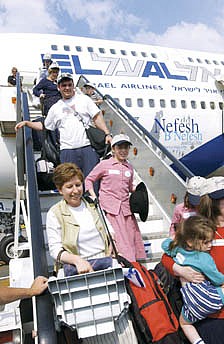
New immigrants arrive at Ben Gurion Airport.
Photo: Ariel Jerozolimski
According to an agreement signed on August 22 but only announced on Sunday, aliya promotion in the United States and Canada will be handled by the private Nefesh B'Nefesh organization. The Jewish Agency will maintain sole rights to determine eligibility and to open files in
official Israeli agencies, but this function will be made accessible
through the NBN Web site.
The agreement marks a shift of responsibility from the large, history-laden Jewish Agency,
whose leadership is appointed by political coalitions of Zionist groups
in the World Zionist Organization, to a tech-savvy organization
utilizing up-to-date business models and marketing strategies.
According to officials in the Jewish Agency, the shift will include largely dismantling the network of 12 aliya shlichim (emissaries) in North America, "redeploying" a few of them and focusing
on Internet-based marketing and communications methods utilized by
Nefesh B'Nefesh for aliya promotion.
The new cooperation has effectively established a
"one-stop shop" for Americans and Canadians interested in aliya,
according to a press release put out by the two organizations.
The agreement comes after months of a bitter turf war between
the organizations. Even the latest press release was delayed for
several days due to disagreement over its phrasing.
The agreement is viewed by
officials in both organizations as a "victory" for Nefesh B'Nefesh,
which has taken over the implementation of aliya policy in North
America from an organization that has held a de facto monopoly over all
aspects of aliya worldwide since its founding in 1929.
"We are pleased to have formalized a working agreement with the Jewish Agency,
and are eager to continue facilitating and promoting North American
aliya in our new enhanced capacity," said Nefesh B'Nefesh co-founder
Tony Gelbart. "This agreement will enable Nefesh B'Nefesh to further
fulfill our mission of making aliya as seamless and successful as
possible."
"The Jewish Agency is confident that as a result of this cooperation with Nefesh B'Nefesh, aliya from North America will grow," Jewish Agency chairman Ze'ev Bielski said.
Despite the apparent loss of turf, a senior Jewish Agency official told The Jerusalem Post that the agency's leadership believed the move would be beneficial for their organization.
"It's a big change. We know it, and we're still learning about
it," the official said. "We've gotten used to being a monopoly where no
one else touches aliya. Now, suddenly we're cooperating with a local
organization."
The Jewish Agency is "an organization built on consensus that tends to be very
conservative," he said, but its ultimate commitment to increasing aliya
has forced it to recognize that "Nefesh B'Nefesh has taken the idea of
a friendlier and more efficient process to a very advanced level."
The new cooperation will mean that olim won't face "two
different organizations, which is confusing," the official said, "but
one [aliya application] form with both our logos, one information
system. It's a collaborative venture."
According to Jewish Community Federation of Cleveland President
Stephen Hoffman, who together with UJA Federation of New York chief
executive John Ruskay and Washington, DC, mediator Kenneth Feinberg
brought the two organizations together to hammer out the agreement, the
final result is a "win-win situation."
"The only issue here was, is there a better way to do the job?
If there is, and somebody is pouring new money into it, it's a huge
win."
According to Hoffman, the work of Nefesh B'Nefesh has changed the debate over aliya in the United States.
Whereas American Jewish leaders used to argue that aliya "was not
something [the US Jewish community] had a big interest in," the
tech-savvy, customer-oriented operating style of Nefesh B'Nefesh "has
got federations saying that this is something different. Suddenly we do
have people who want to make aliya. They've created a buzz about it.
We've gone from aliya in the West being an ideological battle to being
an enthusiastic choice that's being offered to people."
The new excitement surrounding aliya has not yet
translated into significant increases in the number of immigrants.
According to figures compiled by Prof. Chaim Waxman of the Jewish
People Policy Planning Institute, American aliya has accounted for
2,335 olim in 2007, a dramatic rise from the 1,237 who came in 2000,
but not much higher than the 2,253 of 1995.
But Nefesh B'Nefesh can point to a 98-percent retention
rate among olim who come with the organization. This is achieved by a
combination of factors. NBN will only accept olim who have visited
Israel before deciding to immigrate to the country, those who are not
fleeing financial or other sorts of "crises," and those whose personal
situation - "on a case by case basis," according to an organization
official - make a successful absorption more likely. In the new
agreement, those who are eligible for aliya but are not accepted by
Nefesh B'Nefesh will register with the Jewish Agency but still be brought to Israel on NBN-organized flights.
The organization also operates a comprehensive support
network in Israel which helps the new arrivals find work and connect
socially. It offers many olim who immigrate through the organization
loans that are turned into grants after a number of years in the
country. Perhaps most importantly, according to the olim themselves,
Nefesh B'Nefesh workers and volunteers help the immigrants navigate the
complicated Israeli bureaucracy.



