|
www.thejewishweek.comThursday,
February 14, 2008 /
8 AdarI 5768
|
|||||||
|
NY Resources
 |

Have Stethoscope, Will TravelBig-money aliyah package luring some doctors to Israel to combat looming shortage.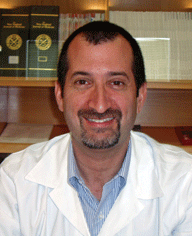
by Stewart Ain For a Woodmere, L.I., pediatrician, the offer of a $60,000 fellowship to move her family to Israel and practice medicine there may be just what the doctor ordered.
But when she makes the move, she’ll be practicing in a country where
doctors earn only a fraction of what they do in the United States. In
fact, most Israeli doctors have to have second jobs just to make ends
meet. “Doctors don’t move there [Israel] “We know we are going to live a less lavish life than in the U.S., but we are not going to starve.” Rosner, 34, is one of several dozen doctors to show interest in the
fellowship, being offered by the Legacy Heritage Foundation through
Nefesh B’Nefesh, an organization dedicated to revitalizing aliyah from
North America and the United Kingdom. The grant, in the form of an
initial fellowship upon arrival in Israel and monthly supplemental
income for the first two years, totals about $60,000. It is available
to doctors under the age of 45 who are willing to practice at least
nine months a year in Israel. A spokeswoman for Nefesh B’Nefesh said the application deadline for
the fellowships is March 15. She said 40 doctors have already
downloaded the form since it became available last month, and that 100
others have expressed interest. Although the foundation has committed
to providing 10 fellowships for each of the next three years — an
outlay of $1.8 million — the spokeswoman said that number might be
increased to accommodate demand. The response is particularly heartening because it comes at a time
when aliyah is at a 20-year low worldwide. However, the number of Jews
making aliyah from North America increased by about 80 percent over the
last five years, according to Nefesh B’Nefesh. Rx For Doctor Drain The fellowship was created in response to a study for Higher
Education’s Planning and Budgeting Committee, which suggested that
Israel will experience a shortage of doctors in the next 10 years. The
report said the current ratio of 3.5 physicians for every 1,000
Israelis is expected to plunge to fewer than 2.5 per 1,000 in the next
few years due to an expected population increase, a shortage of Israeli
medical schools, doctors who are expected to stop practicing medicine
for more lucrative fields, and the retirement of the large number of
doctors from the former Soviet Union who made aliyah in the
1990s. But Dr. Jonathan Halevy, director general of Shaare Zedek Medical
Center in Jerusalem, stressed that “there is no connection between the
evolving shortage of physicians and the fact that right now ... we have
a good medical system.” “Israel has a national health insurance program that covers quite an
impressive basket of services and it is one of the best in the world,”
he said. “Every citizen because of a health tax gets very good medical
care. We don’t have the uninsured you have,” a reference to the more
than 40 million Americans without health insurance. But because of the growing shortage of physicians, Halevy said that
“every physician who comes will find a job, especially in anesthesia,
general surgery and pathology.” Overseas physicians are being recruited, he added, because “it takes
seven years to produce new physicians and in seven years we will have
fewer than three physicians per every 1,000 Israelis. So we will need
hundreds of new physicians starting in 2012.” Rosner said it is a “positive thing to know that you are going to a place that needs you,” she said. “When I found out that there was a lack of pediatricians, it was
inspiring to hear that I could actually make a difference there,” she
said. Rosner said that she, her husband, Rabbi Shalom Rosner of
Congregation Beis Ephraim in Woodmere, L.I., and their five children,
plan to return each summer to work in a camp where her husband is the
rabbi and heads the educational staff. In addition to the fellowship, Rosner said Nefesh B’Nefesh has
agreed to help streamline the process of getting a medical license in
Israel. “I had thought it was going to be very challenging to get my license
and my specialty recognized in Israel,” she said. “Even though you
could be board certified in the U.S., they don’t always transfer it and
allow your specialty to be recognized when you get there. A
psychiatrist friend of mine made aliyah last summer and spent a lot of
time and energy to get her Israeli license. ... So up until now there
had been a lot of red tape.” The fellowship may also make the difference for Dr. Mordechai “Todd”
Lyn, 35, a neurologist who took a sabbatical from his private practice
in Houston to practice medicine in Israel this year to see if Israeli
life was for him. “We arrived in August and it’s been a wonderful experience,” he said. “It’s been fantastic. It’s had its trials and tribulations, especially having children
here. But they have done well and met friends and their Hebrew is
coming along. They have adapted as well as we could have possibly
expected.” His children are ages 6, 3 and 1. His wife, Dikla, was born on a kibbutz and came to the U.S. when she was 5. “We’ve been trying to figure out how we could make it here
financially,” Lyn said. “You don’t make here what you make in the
states. But when we heard that Nefesh B’Nefesh would help me as I get
established over a period of several years and that it would provide me
with opportunities I would not have had, it looks more promising than
if I had just come on my own.” Low Tuition, Free Health Care
He said he has already been approached by a hospital because there is a “specific need” for his specialty. “I’m looking into it,” Lyn said. “The salary is significantly less
but the cost of living here is also significantly less. Tuition is less
compared to a quality yeshiva education in the United States. For the
public school system here, you pay school dues of $100 a year. And for
private schools like yeshiva, it’s $150 a month. And health care is
free. And if you want to go onto a private health care system, the cost
is far less than what it is in America.” “Israel is not America,” Lyn added. “But what is important in
America may not be important in Israel. For instance travel within the
country. You can go from the beach to the snow in a matter of hours –
and you can drive there. People in America have to fly from Florida to
Vail. So if you want to indulge, you can. But there is so much to do
without going into indulgences. ... They really want doctors here, plus
you get to live in Israel. And you feel like Israel is a very
meaningful existence.” An American gastroenterologist who made aliyah two years ago, Dr.
Ian Gralnek, 45, said his three children ages 14, 12, and 9 “adapted
extremely well” even though they did not speak a significant amount of
Hebrew. He said he and his Israeli-born wife had wanted to move to
Israel for a long time. “We finally reached the point in our lives where we said that if we
were going to do it, we had to do it before the kids got too old,” he
said. “I’m from a small family and my kids don’t have first cousins. My
wife is from a pretty big family and that was missing from our lives.” Gralnek, a Conservative Jew, both practices at Rambam Hospital and
is a professor of medicine at the Technion because his hospital salary
“is not enough to support you.” “Most Israeli physicians have other jobs, such as consulting for
biomedical technology companies and working for managed care groups,”
he said. “You don’t starve, but you are not coming here to buy a second
Mercedes. You make tradeoffs in life. It is professionally satisfying.
We’re living in Israel and doing what we wanted to do. The pluses
outweigh the minuses. Although he will not be able to benefit from the fellowship, Gralnek
said he wished he had it because “financial stability for the first two
or three years is important. Things move slowly here in terms of
getting established.” But he said he found that Israelis “crave the American interaction
with patients. I smile and ask questions and I’m cordial. Israeli
physicians [tend to] have tough exteriors and patients like to be
talked to and smiled at and taken care of.” Asked if he planned to spend any time in the U.S. working to enhance his income, Gralnek said he did not. “We made a conscious decision not to want to be dependent on American income,” he said. |
  
|
|||||

 Print this Page
© 2000 - 2008 The Jewish Week, Inc. All rights reserved. Please refer to the legal notice for other important information.