We're
eight miles above the Atlantic Ocean in the cockpit of a Boeing 777. A
full moon, melon-yellow, hangs like a giant balloon in the silent sky.
"This is the most advanced passenger plane in the world. You only need
an experienced pilot when anything goes wrong," says Capt. Gideon
Livni. He is an experienced pilot. He's been flying for El Al for 18
years. Before that, he was full-time IAF.
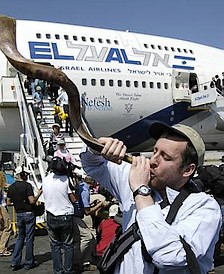
Blowing the shofar upon arrival in Israel [file].
Photo: Nefesh Benefesh
Livni
keeps a watchful eye on the rows of illuminated buttons of the flight
deck, as the management and satellite communications system propels us
eastward from the United States to Israel. But there's time to relish
the passenger log: Tonight he's carrying 240 immigrants, among them 104
children. The oldest passenger is 72, the youngest one month old. That
doesn't count the guests like me on this chartered flight, invited by
Nefesh B'Nefesh, the six-year-old nonprofit organization which spares
no effort to catalyze and facilitate immigration of North American and
British Jews.
Every Zionist cell of my heart is beating fast when I
meet the immigrants at JFK. "Are you making aliya? And are you making
aliya?" I ask them. I can spot the immigrants among the well-wishing friends and relatives who have come to wish them a bon voyage.
THE MIX of excitement and weariness is etched in their
faces. Despite the help of Nefesh B'Nefesh staff at every juncture of
the immigration process, packing and closing up households and planning
for a new life remain a huge challenge. A pregnant mother of five from
Los Angeles has a blaring headache. A father of five from Queens,
originally from Azerbaijan, sounds uncertain as he describes the
forthcoming move to Bnei Brak to make sure his children grow up with
Jewish values. He asks me if I think I made the right decision by
leaving America so long ago and bringing up my children in Israel.
I assure him that I have no regrets. Just the
opposite. I moved to Israel in 1971, the bumper year of all time for
immigration from the US when, according to the Central Bureau of
Statistics, 7,364 Americans took on Israeli citizenship. But as terror
and economic troubles of the second intifada combined with a lull in
immigration, a mere 1,237 Americans became Israelis in 2000.
That
was before Nefesh B'Nefesh reversed this trend. The organization has
brought 36 chartered and 22 group aliya flights, totaling more than
16,000 immigrants from the US, Canada and the UK.
At last, the well-wishers depart, and the passengers fill the wide-bodied jet. They applaud as Capt. Livni takes off.
BY THE time these men, women
and children land - nine hours and change later - they'll step onto
Israeli soil as fully-processed new immigrants. They don't even have to
go through passport control or customs. Interior Ministry reps spend a
sleepless night walking around the plane with electronic PC-Tablets,
the electronic pads that hold the personal details of every immigrant.
These were developed by Nefesh B'Nefesh as one of a myriad of
technological devices aimed at making the notoriously labor-intensive
aliya "paperwork" an anachronism. Their immigrant cards will be waiting
at Ben-Gurion Airport, and three days later they can pick up their ID
cards at the Nefesh B'Nefesh office in Jerusalem. We veteran Israelis
can appreciate this dazzling efficiency even more than the newcomers.
Nonetheless, the operative question remains the same as it was
decades ago: Why are you making aliya? I can still pinpoint the exact
moment I decided to move to Israel. Why are these Americans Jews, from
such a variety of ages, religious practices and lifestyles, uprooting
themselves and casting their lots with the Zionist enterprise?
For Beverlyn Baer, 22, in a sleeveless T-shirt, the decision
was about falling in love. She discovered Israel on a Birthright Israel
free trip, loved it and also one of the soldiers who accompanied her
group of college kids. She came back and volunteered in Ramle for five
months to get better acquainted with the country and the young man. Her
boyfriend will be waiting at the airport and they'll go to either the
Golan Heights or Tel Aviv. They haven't decided yet.
Jo Anne Alderstein is a much-heralded immigrant attorney in New
York. Today she is an immigrant herself. The events of September 11
were a personal wake-up call. On September 5, 2001, she'd moved into
her dream apartment near the World Trade Center. Then her daughter gave
birth to a baby in Israel and Alderstein quit unpacking and caught the
first flight out. Hence, she missed the terror attack. "If that wasn't
a kick in the pants, I don't know what is," she says.
Her dream has changed; her dream apartment is now on
Rehov Emek Refaim in Jerusalem. To remind herself, she'll keep a framed
magazine cover of the New York skyline before 9/11 next to the words
"If I forget thee, O Jerusalem,
let my right hand lose its cunning," at the entrance to her Jerusalem
apartment. "I should have come 30 years earlier," she says. "I knew I
needed to come. The existence of Nefesh B'Nefesh made the transition
easier."
Indeed, the organization is an endless font of practical
information: your rights as immigrants, where to go for Hebrew classes,
how to arrange health insurance and register the kids for school, how
to release your shipment from customs. It also provides financial aid.
But the greatest innovation is the warm welcome and encouragement;
there's nothing ambivalent about its belief in aliya as the ultimate
tool for self-realization and for building the State of Israel.
EBULLIENCE OVERCOMES tiredness on the flight. The immigrants
can hardly sit still and catch up on their sleep. No steward reprimands
them as they crowd the aisles, introducing themselves to others,
jotting down names, ideas. Immigration means starting all over in
acquiring the contacts of people who will be your friends and provide a
safety net for you.
At one bulkhead seat, a young religious couple from New
York are rocking their eight-month-old daughter. The father turns out
to be an Israeli, the son of American immigrants. On a visit to the US,
he met Jenny Rosenfeld, a graduate student in English literature, at a
Shabbat dinner table. It was love at first sight for both of them. They married and waited for her to complete her
doctorate. His name is Pinhas Roth and he's from the Ramot neighborhood
of Jerusalem.


