Ulpan
students who were hoping to return to their studies after the summer
break may find they have no classes to return to, after Education
Ministry Director-General Shlomit Amihai instructed that no Continued
Ulpan classes be opened this academic year. This decision follows an
eight-month battle between the Education Ministry and ulpan teachers
over how to deal with a 38-percent cut in the ulpan budget.
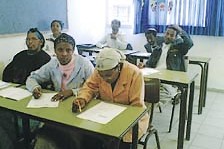
Ethiopian ulpan students
Photo: Courtesy, Gali Zadik
But are five months of Hebrew lessons enough for a new immigrant?
Continued Ulpan
According to the new system, the
Education Ministry will continue subsidizing the first 500 hours (five
months) of a new immigrant's Hebrew studies, Ulpan Aleph (First Ulpan). It will no longer subsidize ulpan studies, known as Ulpan Hemshech (Continued Ulpan), beyond that initial period, except for specialized programs for certain groups.
"Hebrew is not something you can measure in months. [Immigrants]
come with different levels and certain people learn quicker than
others," Danny Pins, the Director of the Division of Immigrants and
Integration of the Joint Distribution Committee in Israel, told Metro.
"For certain people [five months] is wonderful and for other people it's only the beginning," he added.
According to Gali Zadik, an ulpan teacher in Kiryat Yam and head
of the Teachers' Campaign Group which participated in Knesset debates
on the ulpan issue, new immigrants need more than just basic language
tools to properly integrate into society. Immigrants don't just need to
get by in shops and restaurants; they need to find and keep employment,
converse with their children's teachers, negotiate housing contracts,
explain electrical problems to mechanics, make friends - the list is
endless.

The entrance to Ulpan Etzion.
Photo: Gil Zohar
Nir Topper, adviser to the director-general of the Education Ministry, admits that the ministry knows 500 hours of language instruction is not enough to equip anyone to learn a new language and go out and
find a job. But the ministry is working within the limits of a budget,
he explains. It has re-ordered its priorities and decided that the most
important ulpan population is the newest immigrants, those who have
most recently arrived.
"The first goal is to help [new immigrants] find their
place - geographically and mentally. If the budget [increased], maybe
there would be an opportunity to open Continued Ulpans, but right now,
when the minister needs to find a place to cut, this is the place," he
told Metro.
Pins said that if the authorities were "a little more creative,"
additional classes could be made available, either via a
full-fee-for-service arrangement or a partial subsidy. Ulpan Ra'anana,
for example, has until now charged NIS 55 for two months of studies -
approximately 182 hours, but has been ordered by the Education Ministry
to completely cut off Continued Ulpan.
Other institutions however, such as universities, charge "a lot
of money," Pins said, and their intensive courses are only offered at
certain times of the year. The Hebrew Studies Center at Tel Aviv
University charges immigrants $1,200 for its intensive seven-week
summer course, which comprises approximately 175 hours.
Avi Silverman, Adviser for Education and Communities at Nefesh
B'Nefesh, suggests that Continued Ulpan be offered for a nominal fee,
"something that was not hundreds of shekels per month." Silverman
suggests that private tutors could be offered in areas where there are
insufficient students to warrant creating an entire class. Nefesh
B'Nefesh has also put together a list of online resources, including
online group classes.
But at least as far as the Education Ministry is concerned,
education as part of Continued Ulpan was a for-free service. Ministry
spokeswoman Pnina Ben-Shalom explained how "up until now, any fees that
Continued Ulpan students paid ulpans went to the local authorities or
the operating bodies, and not to the Education Ministry."
The ministry is considering whether to provide Continued Ulpan
for a fee, but a nominal payment may not be enough to cover the costs
of the classes. Also, low demand in a particular region may not justify
opening a new class. In that case, immigrants could potentially
continue studying as members of existing First Ulpan classes. The
Education Ministry did not state whether this would be permitted under
the new system, though it said that students who have finished five
months of ulpan have attained a higher level of of facility in Hebrew
than First Ulpan students and cannot continue to study with them.
However, because ulpans offer numerous language levels in First Ulpan studies, this may not be the case.
The Education Ministry recognizes the importance of
providing immigrants with the Hebrew they need in order to work and
will continue to provide specialist Continued Ulpan programs according
to demand, including ulpan for accountants, bookkeepers, lawyers,
courtroom typists, medical and pre-medical professionals, police force candidates and bus drivers.
In addition, some municipalities, such as Tel Aviv,
Jerusalem and Netanya, are implementing Continued Ulpan frameworks for
their new immigrant populations, Ben-Shalom said.
The ministry has also said that regular Continued Ulpan classes
that were running as of January 3, 2008, could continue running until
their scheduled conclusion. There will also be no changes to Continued
Ulpan for Ethiopian and disabled immigrants.
10 years down to 18 months
Until now,
immigrants have had 10 years in which to exercise their entitlement to
500 hours of subsidized First Ulpan. That gave them time to find a
house, put their children in school and get established in the country before committing themselves to full-time study.
The new system, says Topper, will return to the original
set of regulations set by the Education Ministry. Immigrants will now
have 18 months to exercise their First Ulpan entitlement.
Pins, however, points out that for some people, getting off the
plane and studying Hebrew right away is not effective. "They're
processing so many other things," he said. Studying Hebrew should be an
ongoing opportunity... whether they just arrived or whether they've
been in Israel for several years."



